Sleeping in a Tesla Model Y: our report after 10 nights
Yes, you can sleep very well in a Tesla Model Y — as long as you know what you gain and what you won’t find there. In October 2026 we spent 10 nights in a Model Y fitted with a Y-Camper prototype, on a 19-day, 4,500 km road trip through Spain. Here is what we took away from it: comfort, space, getting in and out of bed, what we packed, and the limits we would rather tell you about now.
People who watched us go to bed didn’t quite believe it. In the morning, we were well rested.
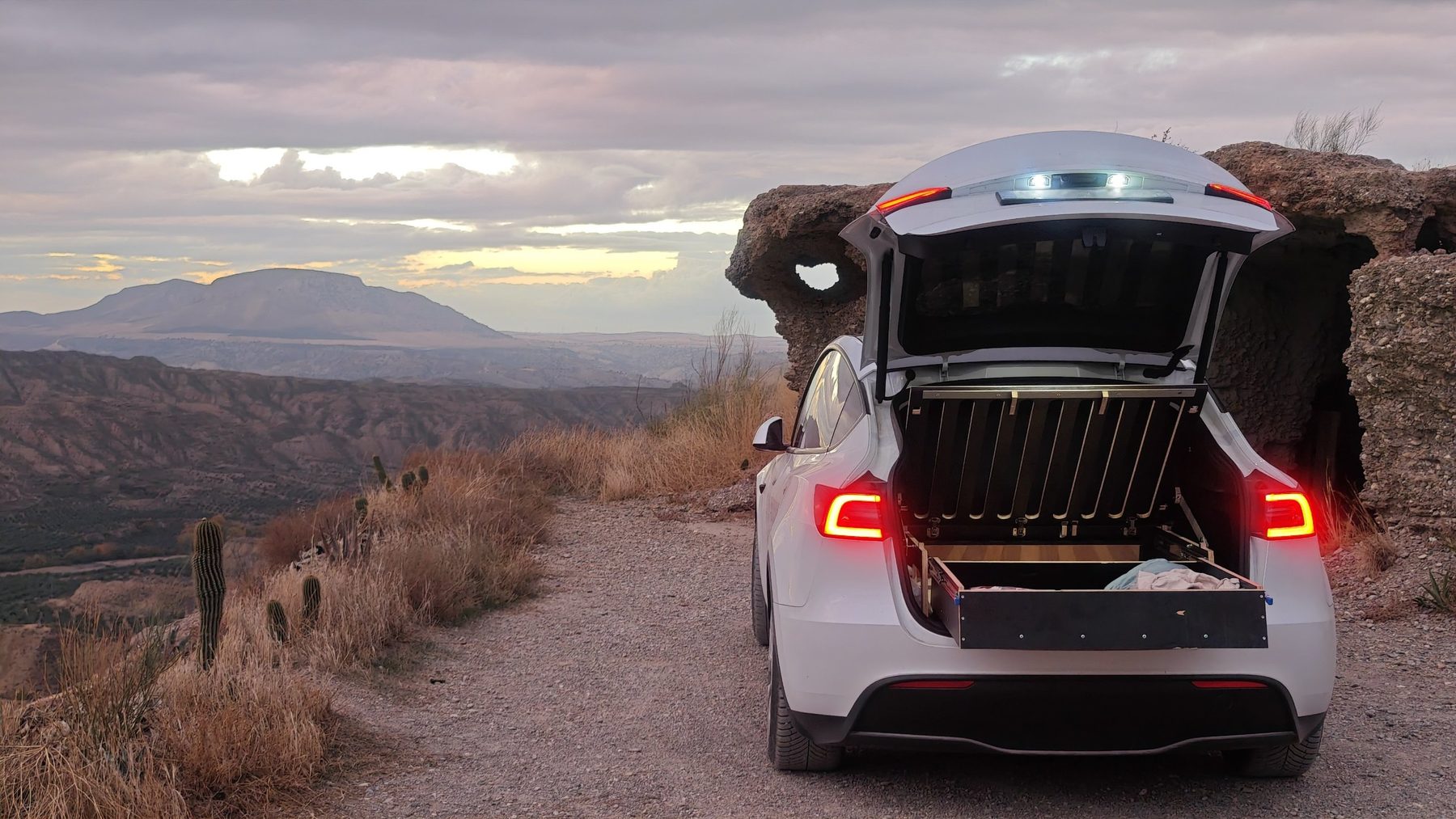
Our test at a glance
| Vehicle | Tesla Model Y Rear-Wheel Drive (pre-facelift), fitted with a Y-Camper prototype |
|---|---|
| Trip | 19 days, 4,500 km in Spain, October 2026 |
| Nights on board | 10, all at campsites |
| Weather | Dry, no rain |
| Temperatures | 14 to 20 °C at bedtime, 5 to 12 °C on waking (5 to 30 °C over the trip) |
| Occupants | 2 adults, one of them 1.87 m tall |
All our nights were spent at campsites. Picnics and naps happened along the way, outside campsites.
Comfort: the real surprise
The bed is very comfortable, and two people don’t get in each other’s way. This is what surprises people most when they haven’t tried it.
- The surface. The bed is 195 cm long, 135 cm wide at the shoulders and 100 cm at the feet: it follows the shape of the cabin, which narrows towards the rear.
- The height. Lying down, there are 64 cm between the mattress (4 cm thick) and the ceiling at head level: enough to read or turn over without bumping your head (tip: if you want to watch a video on your phone, bring a selfie stick you can wedge between the mattress and the roof, so you don’t have to hold the phone!).
- The mattress. We used a self-inflating two-person car mattress with adjustable length. That last point matters: the bed’s headboards are telescopic, and an adjustable mattress shortens along with it (a standard mattress has to be folded when the headboards are retracted).
- Bedding from home. This is where comfort is won. We brought our two single duvets and our usual pillows: you sleep as you do at home, and each person has their own duvet.
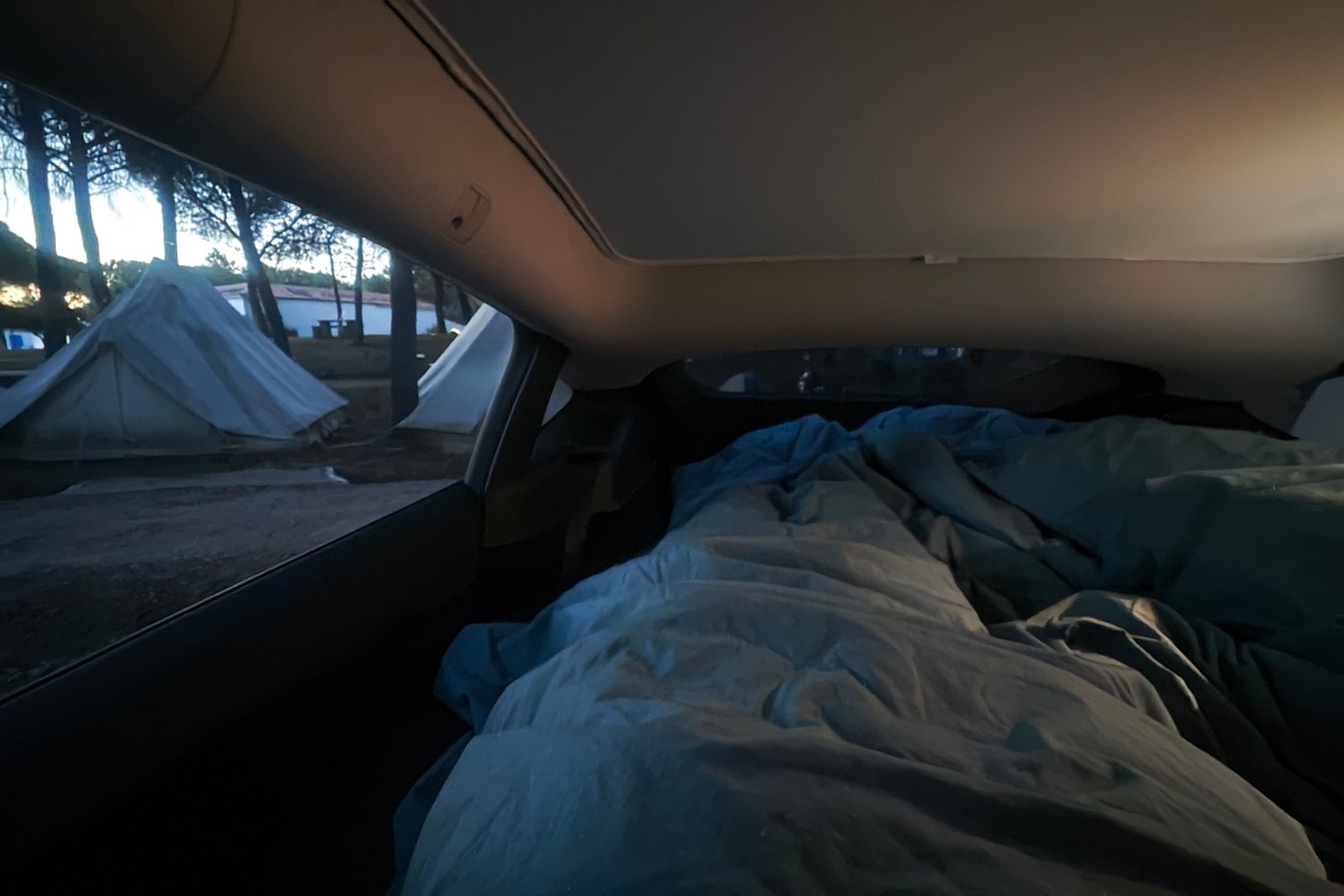
- No boxed-in feeling. The windows and doors open directly from the bed. Knowing you can get out or let in air in one movement is enough to reassure anyone who fears feeling shut in. And as long as the glass roof isn’t covered, your gaze carries far outside: the feeling of space goes well beyond the actual 64 cm.
Tall and broad sleepers: what fits, what doesn’t
Height is not a problem; getting into bed is the tight part. We’d rather give you the measurements so you can judge for yourself.
Length. One of us is 1.87 m tall and was never cramped. With a 195 cm bed, you sleep fine up to about 1.90 m.
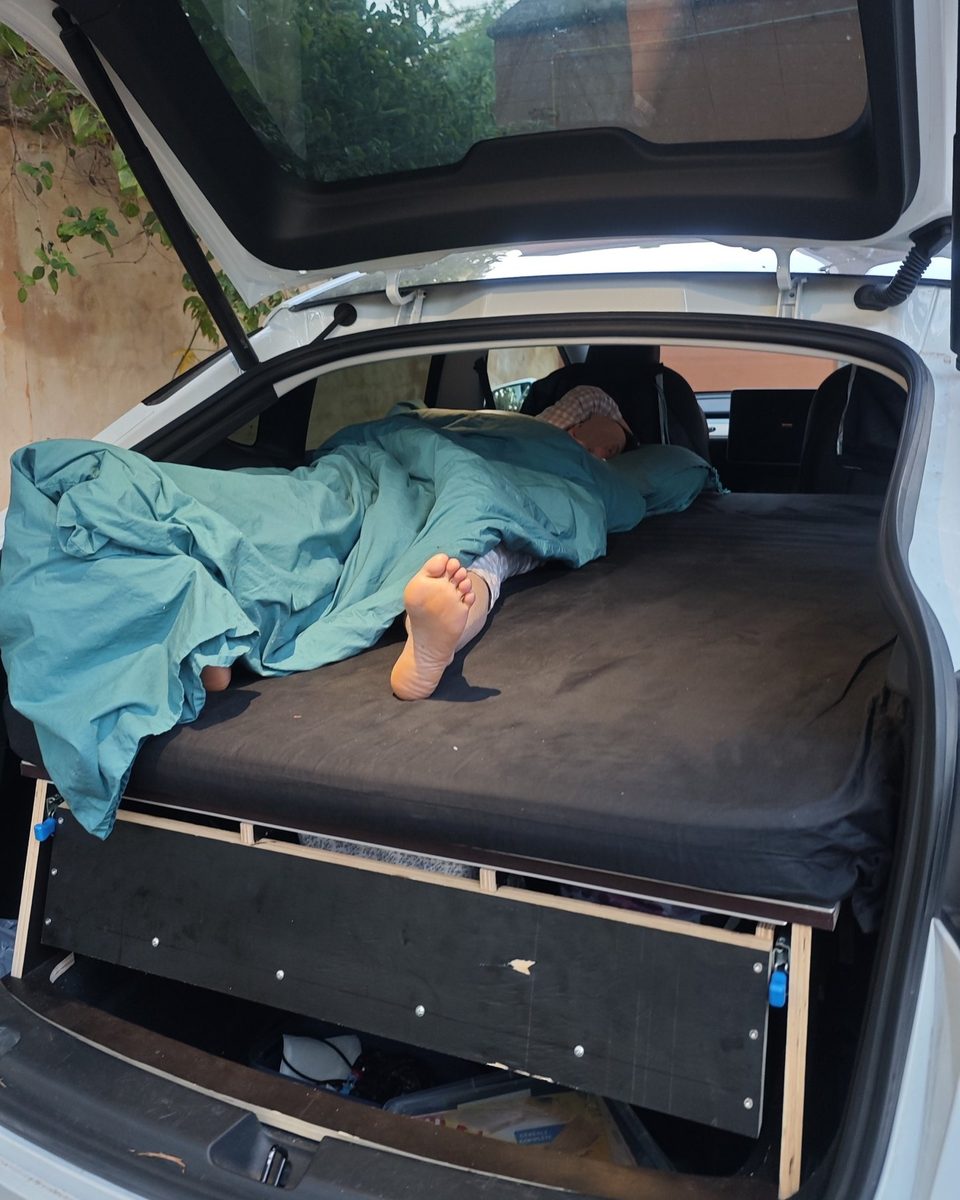
Getting in and out. You reach the bed through the tailgate or the rear doors. In practice we found the side doors the most convenient. Either way the opening is fairly tight: it takes a knack, but it’s doable! Here are the dimensions to compare with your build:
| Access | Width | Clear height above the mattress* |
|---|---|---|
| Tailgate | 100 cm | 46 cm |
| Rear door | 70 cm | 50 cm |
*4 cm thick mattress.
Height is the limiting factor: less than 50 cm above the mattress in both cases, so you have to bend down well to get in. The door gives a little more height than the tailgate, which is why we prefer it.
Compare these figures with the width of your shoulders and hips: that’s the gap you’ll go through every evening.
Switching to night mode: 5 minutes, nothing to unpack
In the evening, switching to night mode takes 5 minutes by the clock, and everything stays in its place inside the car. No need to empty the trunk or put bags outside to go to bed.
The rear seats are already folded; you slide the front seats forward, unfold the bed’s headboards and roll out the bedding. In the morning you do the reverse, and the car is a car again.
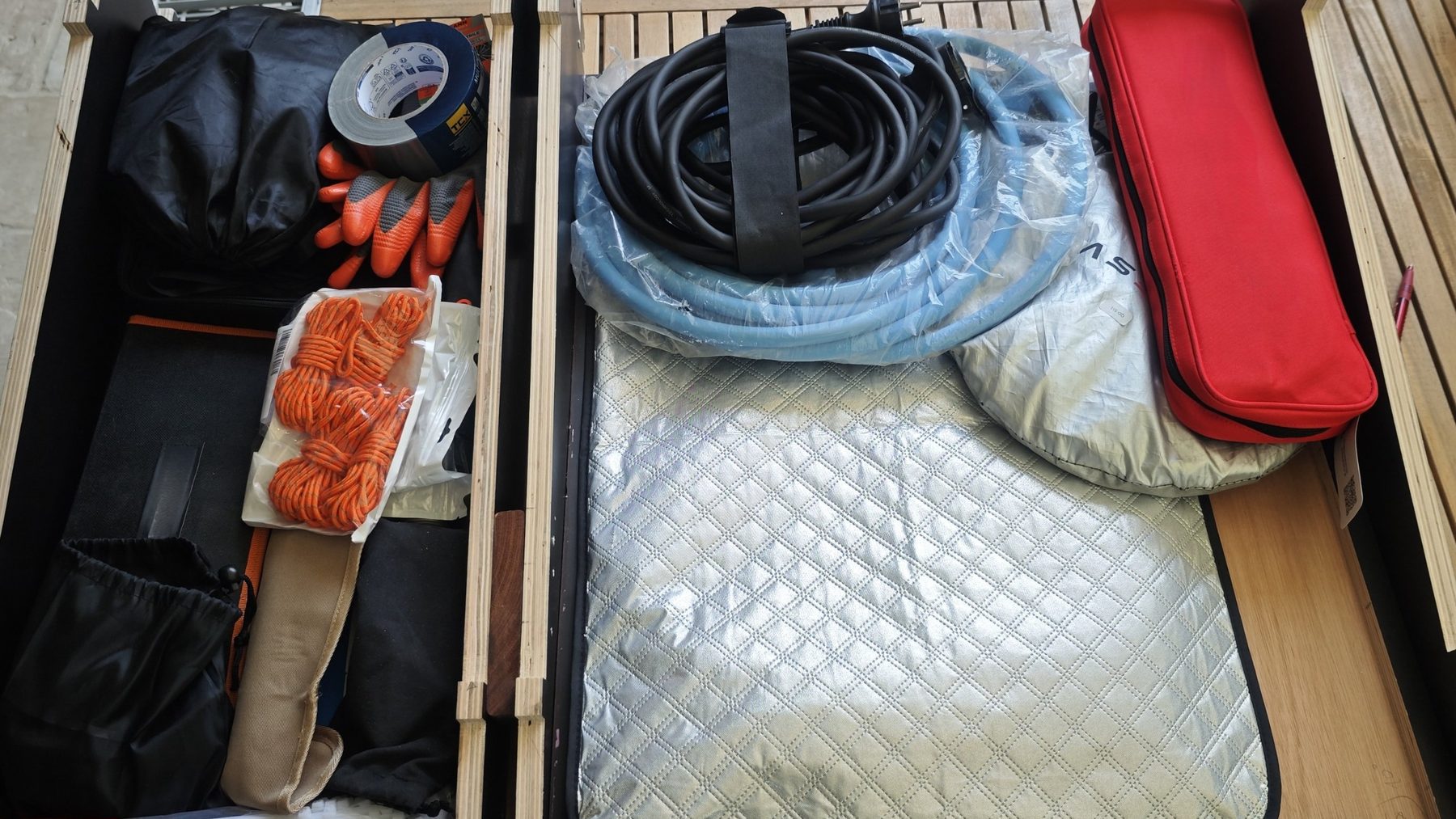
This works because your belongings live under the bed. In bed configuration, the kit offers 358 litres of storage:
| Storage | Volume |
|---|---|
| Space and well under the drawer | 173 L |
| Drawer | 95 L |
| Front left compartment | 58 L |
| Front right compartment | 32 L |
| Total, kit | 358 L |
| Model Y front trunk (frunk), in addition | 117 L |
We stored clothes and toiletries, camping gear, charging equipment (charger, cables, extension lead), a toolkit… One rule soon sets in: “a place for everything, and everything in its place”. This is a car, not a van.
The night on board: temperature, light, noise
The Model Y’s Camp Mode does much of the work: 18 °C all night and no condensation on the windows. We set it to 18 °C every evening, while it dropped to 5 °C outside by morning.
- Condensation. None, not a single night. A real advantage over a tent or an unheated vehicle.
- Noise. You can hear the heat pump running, but keeping the temperature remains discreet. Turn Auto off and set the fan to level 1: otherwise the airflow can be bothersome and noisy.
- Light. The lamps above the rear doors fall right within reach and make excellent reading lights.
- Darkness. With blackout panels the cabin becomes completely dark. Yet we did without them most of the time, for the pleasure of waking up with the daylight. Because the rear windows (side, quarter and tailgate) are privacy-tinted, nobody can see inside from outside at night: you see out without being seen, as long as the cabin stays dark.
- Battery. A night from 10 pm to 8 am cost us about 10% of the battery (6 kWh), plus about 5% (3 kWh) for our electric cool box. Plugged into the campsite socket, we lost nothing, and even gained a little.
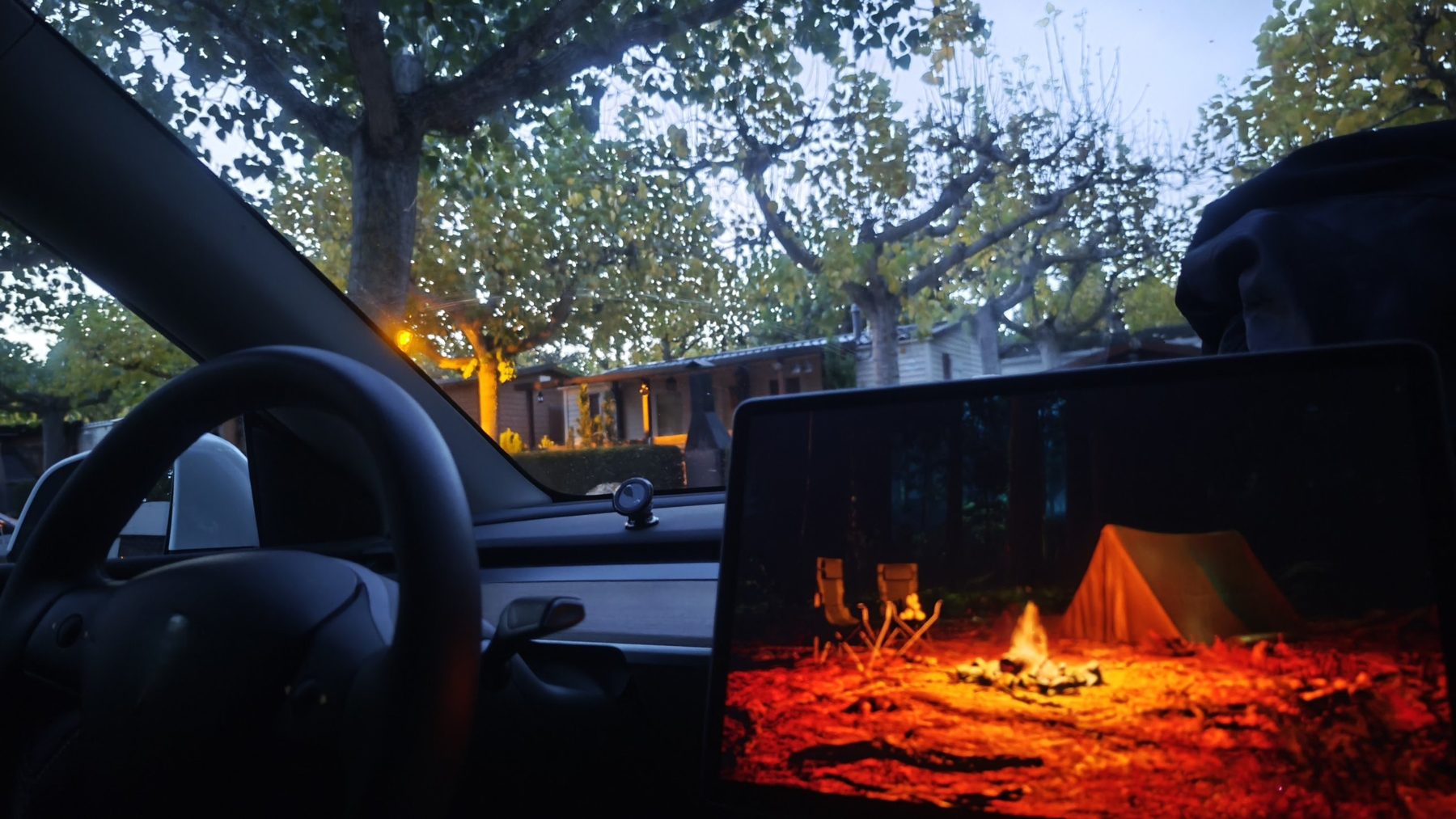
Turning it on, the settings not to forget, detailed consumption and charging at campsites: it’s all in our guide Tesla Camp Mode: settings and real-world consumption.
What we packed
Here is our actual list, tested over 19 days. Everything found its place on board.
For sleeping
- Self-inflating two-person car mattress, adjustable length
- Two single duvets and our pillows from home
- Blackout panels (optional)
For living outdoors
- Freestanding 2 × 2 × 2 m pop-up shelter, up or down in under 5 minutes
- Folding table and chairs
- Gas stove, 4-person cook set, kettle and coffee maker
- 24-litre compressor cool box on the 12 V socket
- Collapsible washing-up bowl
- LED lamps and a head torch
- Washing line and pegs
For the car
- Standard home charger
- Campsite adapter: blue 3-pin plug to household socket (about €10, essential)
- 10 or 20 m extension lead, 3 × 2.5 mm², CE-marked: the campsite hook-up is often far from your pitch
- Type 2 to Type 2 charging cable (mode 3), for public charging points — never used, but reassuring
- Jack, lifting pads, plug-type tyre repair kit and electric inflator
What a Model Y won’t replace
Y-Camper doesn’t turn your Model Y into a van or a motorhome: it lets you sleep well and store everything. That’s already a lot, but three things are clearly missing:
- a shower,
- a toilet,
- a sink.
We considered taking portable versions, then gave up: too bulky, too awkward to use. Our solution is simple: a collapsible bowl for small washing-up and vegetables, and campsite or rest-area facilities for showers, toilets and bigger washing-up.
Plan a shelter for meals. The cabin is for sleeping, not for cooking or sitting at a table, and evenings and early mornings can be chilly. Our freestanding shelter, set up next to the car, let us have dinner and breakfast warm and sheltered. We consider it almost essential.
What about rain? We had none. We will soon test a tailgate tent attached to the car, and will update this guide.
And away from campsites?
We slept only at campsites, but nights elsewhere are possible. Three conditions:
- Arrive with enough battery. Camp Mode stops below 20%. Start the night with at least 30 to 35%, or 40 to 45% with an electric cool box.
- Bring water for drinking, cooking and washing.
- Accept a quick wash until the next facilities.
Depending on the season, a shelter is still useful for meals or getting dressed. Before stopping for the night, also check local rules: parking and camping are not the same thing, as we explain in Sleeping in your car in France: what the law says.
Frequently asked questions
Can two people really sleep in a Model Y?
Yes. With a 195 × 135 cm bed (100 cm at the feet), two adults sleep without getting in each other’s way. We did it 10 nights in a row.
How tall can you be to sleep in a Model Y?
Up to about 1.90 m without discomfort, based on our test (1.87 m with no problem at all).
Does the car need to be modified?
No. You slide the front seats forward for the night, and the kit sits in the cabin with no modification to the vehicle.
How long does it take to switch from driving to night mode?
About 5 minutes, without taking anything out of the car. The day you receive Y-Camper, allow 15 to 30 minutes to fit it. After that, you’re done: it stays in place.
Do you get cold at night?
No: Camp Mode holds the chosen temperature (18 °C for us) with 5 °C outside, with no condensation on the windows.
How much battery does a night use?
About 10% (6 kWh) for a night from 10 pm to 8 am, with 20 to 5 °C outside, plus about 5% for an electric cool box. Plugged in at a campsite, the car loses nothing.
In short
Sleeping in a Tesla Model Y means a real bed, a controlled temperature and all your gear within reach, without emptying the trunk every evening. It isn’t a motorhome: no shower, no toilet, and a tight way into bed. If that trade-off suits you, it’s a very simple way to travel.
Y-Camper is coming soon. Pre-book for free, with no commitment, to be contacted first.